


Quick Summary
Mangools focuses on simplicity and affordability, making it a great option for beginners and smaller websites. Ahrefs, on the other hand, offers deeper datasets and more advanced SEO analysis, especially for backlinks and competitor research. In this guide, we compare Mangools vs Ahrefs across pricing, keyword research, backlink analysis, competitor insights, and ease of use. We’ll also look at how SEMrush fits into the picture and why some marketers consider it a strong alternative.
Mangools vs Ahrefs vs SEMrush: Where Should You Put Your Money?
In a previous post, I compared Mangools vs Semrush for people trying to decide whether the affordable simplicity of Mangools is enough, or if the all-in-one marketing power of Semrush justifies the higher price.
But another comparison shows up just as often in SEO communities: Mangools vs Ahrefs. The pattern is pretty common. Many beginners start with Mangools because it’s simple, affordable, and great for keyword research. But as their SEO work grows, they start hearing the same thing over and over:
“If you’re serious about SEO, you should be using Ahrefs.”
So the real question becomes:
Is Mangools good enough, or is Ahrefs actually worth the upgrade?
In this guide, I’ll break down the differences between the two tools to help you decide which one makes sense for your workflow.
Mangools vs Ahrefs at a Glance
Before diving deeper into the details, here’s a quick look at how Mangools and Ahrefs compare across some of the areas that matter most when choosing an SEO tool.
| Feature | Mangools | Ahrefs |
| Best for | Beginners, bloggers, and small websites | SEO professionals and agencies |
| Keyword Research | KWFinder for finding low-competition keywords | Keywords Explorer with deeper keyword insights |
| Backlink Analysis | LinkMiner for backlink exploration | Site Explorer with one of the largest backlink databases |
| Competitor Analysis | SERPChecker and SiteProfiler for quick insights | Deep competitor analysis through Site Explorer |
| Rank Tracking | SERPWatcher for monitoring keyword rankings | Rank Tracker with historical ranking data |
| Ease of Use | Very beginner-friendly interface | More advanced tools with a learning curve |
| Database Size | Smaller keyword and backlink datasets | Very large backlink and keyword index |
| Pricing | Budget-friendly | Premium pricing |
Mangools vs Ahrefs: Key Differences
Pricing and Affordability
Mangools is positioned as an affordable SEO toolkit, while Ahrefs sits on the premium side of the SEO tools spectrum.
Mangools pricing is relatively accessible. You can get access to the platform for between $19 to $49 per month if paid annually, and about $31 to $71 if paying monthly.

Regardless of the plan you choose, you still get access to the full suite of tools — KWFinder (for keyword research), SERPChecker (for analyzing SERP competition), SERPWatcher(for rank tracking), LinkMiner (for backlink exploration), and SiteProfiler (for quick domain insights). The main difference between the plans is mostly the usage limits — things like the number of keyword lookups, tracked keywords, and backlink rows you can analyze.
Ahrefs, on the other hand, sits on the higher end when it comes to pricing. You’ll typically need to budget between $108 to $374 per month if paying annually, or $129 to $449 per month if paying monthly, depending on the plan you choose.
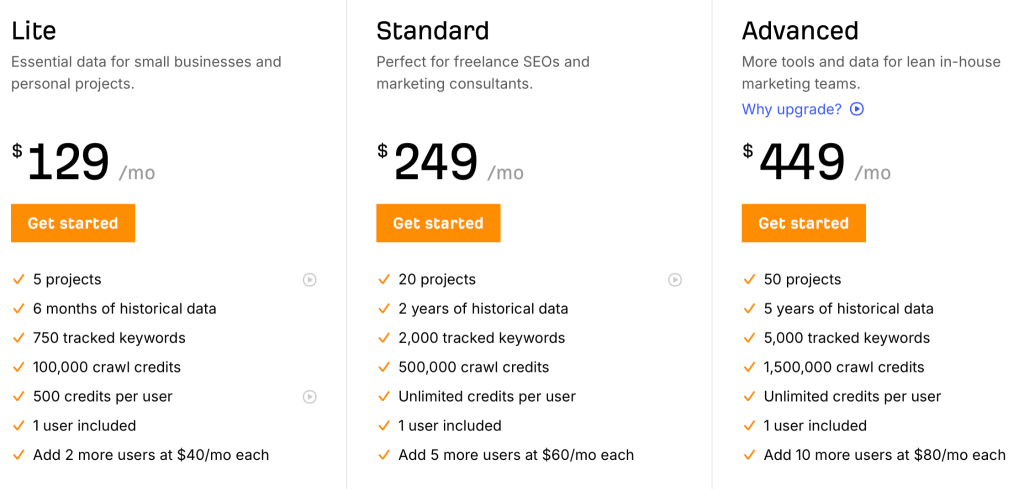
Each plan includes access to tools like Site Explorer, Keywords Explorer, Content Explorer, Rank Tracker, and Site Audit, with higher tiers increasing the number of reports, projects, and data limits. There’s also the Ahrefs Starter plan at $29/month, which provides limited access to some core features and is mainly designed for smaller projects or users who want to try the platform before committing to the full subscription.
While Ahrefs may look expensive and Mangools appears far more affordable, pricing alone doesn’t tell the full story. Ahrefs typically offers much larger datasets and deeper analysis, especially for backlink intelligence and competitor research.
So the simple takeaway is this: if you’re just getting started or working on a smaller project, Mangools is usually the more practical option. But if you’re running more serious SEO campaigns and need deeper data, Ahrefs is often where many professionals eventually end up.
Backlink Analysis
Ahrefs clearly takes the lead when it comes to backlink analysis, while Mangools works better for quick backlink checks.
In fact, Ahrefs is the clear winner against Mangools in this area. Even among users who like Mangools, this limitation comes up often. One Reddit user summed it up bluntly: “Backlink data was the big let down when it came to Mangools.”
And looking at it beyond what users say, the difference becomes quite obvious.
Mangools realistically stops at tools like LinkMiner, which allows you to explore backlinks pointing to a page or domain, check metrics like link strength, filter links based on dofollow or nofollow, and even preview the linking page directly. For quick backlink exploration or simple link checks, it does the job fairly well.
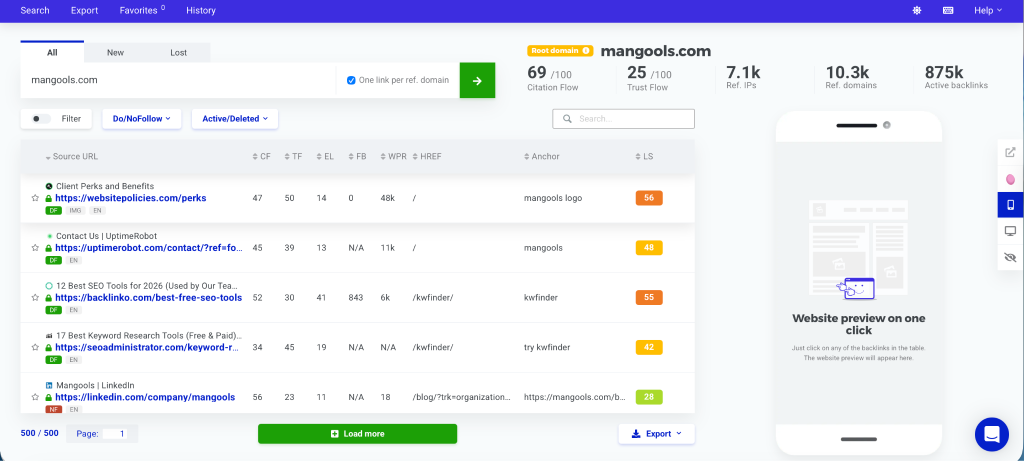
Mangools Link Miner UI
Ahrefs takes things much further. With Site Explorer, you can analyze a site’s complete backlink profile, discover new and lost backlinks, see which pages attract the most links, and understand how competitors are building their link authority. Users often praise Ahrefs for how easy it makes it to uncover competitor link opportunities.

Backlinks Section of Site Explorer UI
Another useful Ahrefs feature is Link Gap, which helps you identify websites linking to your competitors but not to you—a powerful way to discover potential link-building opportunities. On top of that, Ahrefs runs one of the largest backlink databases in the SEO industry, powered by its own web crawler. This means it often surfaces more link data and deeper insights compared to smaller SEO tools.
And that’s really what separates the two here. Mangools helps you find backlinks, Ahrefs helps you understand the entire link landscape behind a site.
Ease of Use
Mangools is designed to be simple and beginner-friendly, while Ahrefs is built to provide deeper SEO insights with more advanced tools.
Both Mangools and Ahrefs have interfaces that are fairly clean and modern. The main difference isn’t really the design, it’s the depth of information each platform presents to the user.
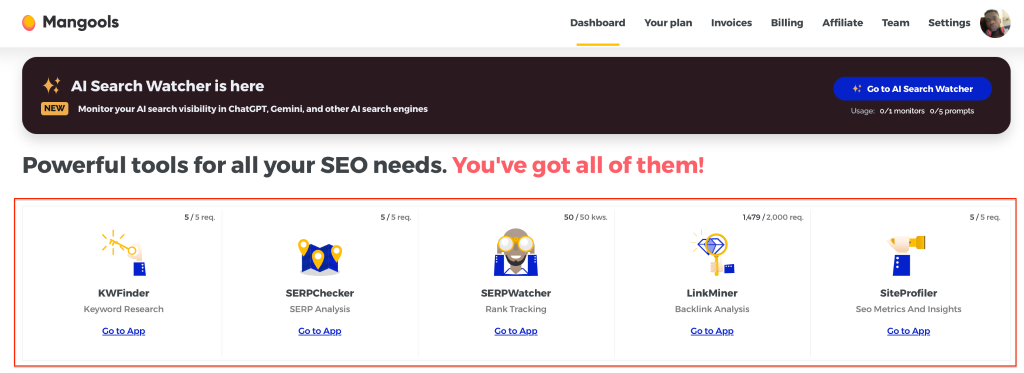
Mangools Dashboard
Looking at the dashboard above, you can see how easy it is to move between the different tools and quickly start a keyword search or SERP analysis. Even users who have little experience with SEO tools tend to find the interface straightforward.
One user review puts it this way: “The UI is fast, intuitive, and ideal for agencies and SMBs that want reliable insights without enterprise complexity.”
With this level of simplicity, it’s easy to jump into keyword research, analyze competition, and track rankings without spending much time figuring out where things are.
Ahrefs also has a well-designed interface, but because of the number of tools and the depth of data available, it can feel more overwhelming at first, especially for beginners. Some users point this out in reviews as well.
One reviewer described it like this: “I find Ahrefs overwhelming with information when logging in. It’s very number-heavy and data-centric, which can be quite daunting.’’
So while both platforms are well built, Mangools tends to feel easier to learn, while Ahrefs offers more depth once you understand how to navigate it.
Keyword Research Capabilities
Mangools is built to make keyword research simple and fast, while Ahrefs focuses on giving users deeper keyword insights and broader search data.
Keyword research is the backbone of most SEO strategies, so both tools put a lot of focus here.
With Mangools, keyword research is handled through KWFinder, which is one of the most popular tools in the Mangools suite.
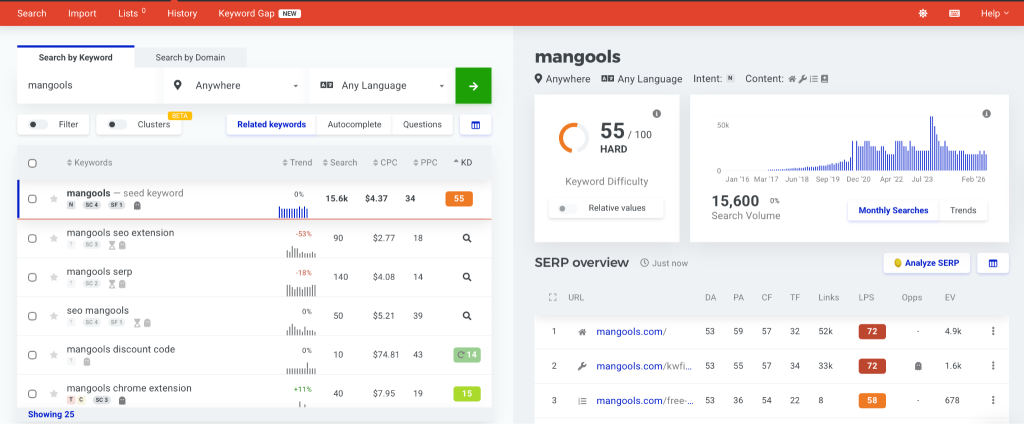
You simply enter a seed keyword and it generates keyword suggestions along with metrics like search volume, keyword difficulty, and SERP analysis. What makes KWFinder stand out is how easy it is to use. The interface is clean and the data is presented in a way that makes it easy to quickly identify low-competition keywords, which is why many bloggers and smaller site owners like it.
Ahrefs approaches keyword research differently through its Keywords Explorer tool. Instead of focusing mainly on keyword suggestions, Ahrefs tries to give you a bigger picture of the search landscape.

In addition to search volume and keyword difficulty, it provides metrics like traffic potential, parent topics, click data, and SERP history, helping you understand how much traffic a page could realistically generate. This makes Ahrefs particularly useful for larger content strategies or competitive niches, where you need more data to understand how difficult a keyword really is to rank for.
So while Mangools makes it easier to find simple keyword opportunities quickly, Ahrefs gives you the deeper insights needed to plan more complex SEO campaigns.
Competitor Analysis
Mangools makes competitor analysis simple and quick, while Ahrefs provides a much deeper way to study competitors’ SEO strategies.
When doing competitor analysis, most SEOs are usually trying to figure out things like:
- who their real search competitors are
- which keywords those competitors are ranking for
- what content is bringing them traffic
- and where they’re getting their backlinks from
Mangools helps with some of these through tools like SERPChecker and SiteProfiler. With SERPChecker, you can analyze the current search results for a keyword and quickly see metrics like domain authority, page authority, backlink strength, and other indicators that help you judge how difficult it might be to rank.
SiteProfiler, on the other hand, gives you a quick overview of a domain, including its domain authority, backlink profile, and top-performing content. For smaller projects or quick competitor checks, this is usually enough to get a general idea of who you’re competing with.
Ahrefs, however, takes competitor analysis several steps further. Using Site Explorer, you can break down a competitor’s entire SEO strategy, from the keywords they rank for to the pages that generate the most organic traffic. You can also see which pages attract the most backlinks and which keywords are driving the majority of their search visibility.
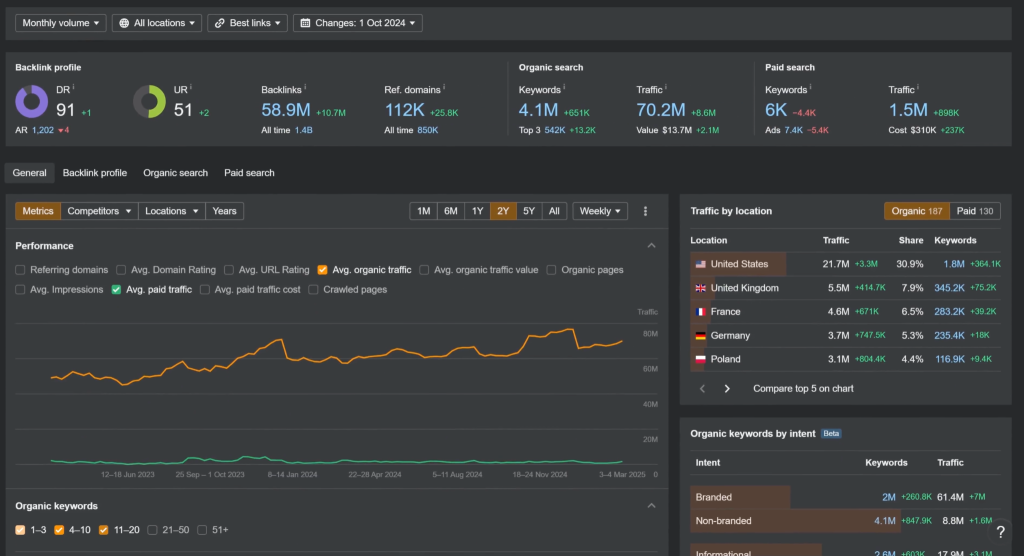
Ahrefs also provides tools like Content Gap, which helps you discover keywords your competitors rank for that your site doesn’t. This makes it much easier to uncover new content opportunities.
Because of these deeper insights, Ahrefs tends to be more useful when you’re trying to reverse-engineer a competitor’s SEO strategy, while Mangools works better for quick competitive checks and simpler analysis.
What is Mangools?

Mangools is an SEO toolkit designed to make SEO research simple and accessible, especially for beginners, bloggers, and smaller website owners. Instead of trying to be an all-in-one marketing platform, Mangools focuses on a handful of core SEO tasks like keyword research, SERP analysis, rank tracking, and backlink exploration. The tools are built with a clean interface and straightforward metrics, which makes it easier for users to quickly understand what they’re looking at.
Key Features of Mangools
Mangools is made up of five main tools, each designed to handle a specific part of the SEO workflow.
- KWFinder: This is Mangools’ keyword research tool. It helps users discover keyword ideas, check search volumes, and evaluate keyword difficulty before targeting a topic.
- SERPChecker: SERPChecker analyzes the search results for a keyword and shows key metrics about the ranking pages, helping users understand how competitive a keyword might be.
- SERPWatcher: SERPWatcher is the rank tracking tool that allows users to monitor how their pages are performing in search results over time.
- LinkMiner: LinkMiner helps users explore backlinks pointing to a website or page and evaluate the strength of those links.
- SiteProfiler: SiteProfiler provides a quick overview of a domain’s authority, backlink profile, and general SEO performance.
Pros and Cons of Mangools
Pros
- Very beginner-friendly interface
- Affordable pricing compared to larger SEO platforms
- Excellent keyword research workflow with KWFinder
- Simple tools that are easy to learn quickly
- Clean dashboard that makes SEO data easier to interpret
Cons
- Smaller keyword and backlink databases compared to larger SEO tools
- Limited advanced SEO analysis features
- Competitor research is not as deep as platforms like Ahrefs or Semrush
- Fewer integrations with other marketing tools
Mangools Pricing
Mangools offers three main pricing tiers, with costs varying depending on whether you choose monthly or annual billing. If billed annually, the plans typically range from about $19 to $49 per month, while monthly billing ranges roughly from $31 to $71 per month.
What is Ahrefs?
Ahrefs is one of the most widely used SEO platforms in the industry, known for its deep datasets and powerful research tools. While tools like Mangools focus on simplicity and affordability, Ahrefs is built to help users analyze SEO at a much deeper level. It allows marketers, agencies, and SEO professionals to study keywords, competitors, backlinks, and overall search performance with a high level of detail.
One of the reasons Ahrefs has become so popular is its massive web crawler and backlink index, which allows it to collect large amounts of data about websites across the internet. This data powers many of its research tools and makes it particularly strong when it comes to competitor analysis and backlink intelligence.
Key Features of Ahrefs
Ahrefs includes several powerful tools that cover different parts of the SEO workflow.
- Site Explorer: This is one of Ahrefs’ most popular tools. It allows users to analyze any website’s backlink profile, organic traffic, and top-performing pages.
- Keywords Explorer: Ahrefs’ keyword research tool helps users discover keyword opportunities while also showing metrics like search volume, keyword difficulty, traffic potential, and SERP history.
- Content Explorer: Content Explorer helps users discover popular content across the web based on backlinks, organic traffic, and social engagement.
- Site Audit: This tool scans websites to identify technical SEO issues that might affect search performance.
- Rank Tracker: Rank Tracker allows users to monitor keyword rankings over time and track how their SEO efforts are performing.
Pros and Cons of Ahrefs
Pros
- One of the largest backlink databases in the SEO industry
- Powerful competitor research and backlink analysis tools
- Large keyword database with detailed search metrics
- Advanced SEO insights that help with strategic planning
- Reliable data for analyzing search performance
Cons
- Higher pricing compared to many SEO tools
- Learning curve for beginners due to the number of features
- Credit-based usage limits on some reports
- Can feel overwhelming for smaller SEO projects
Ahrefs Pricing
Ahrefs is generally considered a premium SEO tool, and its pricing reflects that. The platform offers several plans depending on usage limits and features. When billed annually, the pricing typically ranges from about $108 to $374 per month, while monthly billing ranges roughly from $129 to $449 per month. Higher-tier plans increase limits for things like the number of projects, tracked keywords, reports, and historical data access.
Ahrefs also offers a Starter plan at around $29 per month, which provides limited access to some core features. This plan is designed mainly for smaller projects or users who want to explore the platform before committing to the full subscription.
Should You Start with Mangools and Upgrade to Ahrefs Later?
For beginners, that’s actually a pretty common path.
Many people start with Mangools because it’s affordable and easy to use. It gives you enough tools to handle keyword research, track rankings, and analyze search results without committing to an expensive platform.
But as SEO work grows — especially when dealing with competitive niches, deeper backlink research, or multiple websites — the need for larger datasets and more advanced analysis becomes more important. That’s usually when tools like Ahrefs start to make more sense.
That said, experienced SEOs or agencies rarely follow this path. If you already know you’ll need deep backlink intelligence and large keyword datasets, you’ll likely go straight to Ahrefs.
So in practice, Mangools often works best for getting started, while Ahrefs is better suited for more advanced SEO work.
Best Alternative to Mangools & Ahrefs: SEMrush
While Mangools and Ahrefs are often compared directly, another tool that frequently enters the conversation is SEMrush.
The reason is simple: both tools solve part of the SEO puzzle, but each comes with its own limitations.
Mangools is affordable and easy to use, but its datasets are smaller and its competitor research and backlink analysis don’t go as deep as larger platforms. Ahrefs, on the other hand, provides much deeper SEO insights but it’s expensive and still focuses mostly on SEO.
This is where SEMrush tends to stand out.
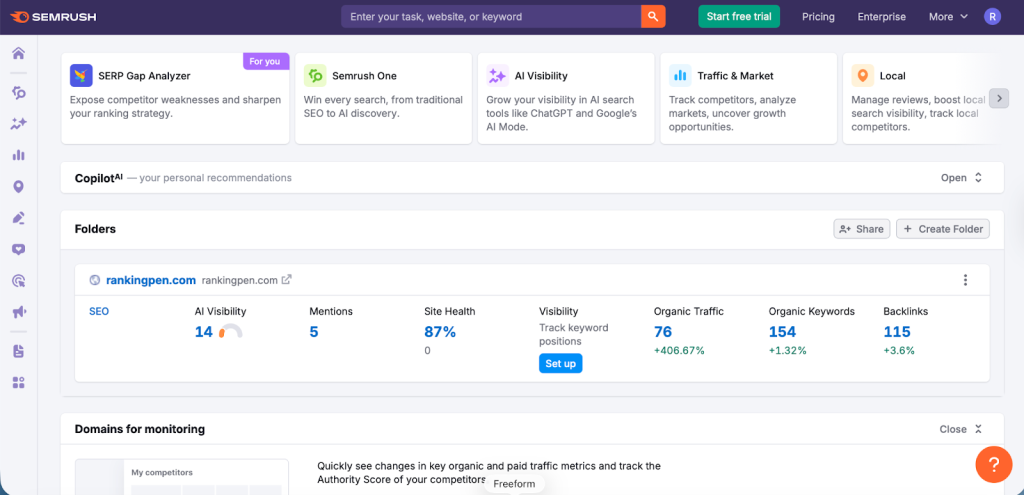
Instead of focusing only on keyword research or backlink intelligence, SEMrush takes a broader approach to digital marketing. The platform combines SEO tools with features for content marketing, PPC research, technical SEO audits, and competitor intelligence across multiple channels.
This way, you can research keywords, analyze competitors, audit your website, plan content, and even study paid advertising strategies from one platform instead of juggling multiple tools.
Key Features of SEMrush
SEMrush includes a wide range of tools that support different parts of the marketing workflow.
- Keyword Magic Tool: A large keyword database that helps users discover keyword ideas, analyze search intent, and explore related keyword opportunities.
- Domain Overview: Provides a snapshot of a website’s organic traffic, paid search performance, backlinks, and overall search visibility.
- Site Audit: Scans websites for technical SEO issues that could affect search performance.
- Backlink Analytics: Allows users to explore backlink profiles, monitor link growth, and identify link-building opportunities.
- Position Tracking: Tracks keyword rankings across different locations, devices, and search engines.
- Content Marketing Toolkit: Helps users generate topic ideas, optimize content, and monitor content performance.
Pros and Cons of SEMrush
Pros
- Comprehensive digital marketing platform
- Strong keyword research and competitor analysis tools
- Powerful site audit and technical SEO features
- Large keyword database and detailed search insights
- Useful tools for both SEO and paid advertising campaigns
Cons
- Higher pricing compared to simpler SEO tools
- Large number of tools can feel overwhelming at first
- Some advanced features require higher-tier plans
SEMrush Pricing
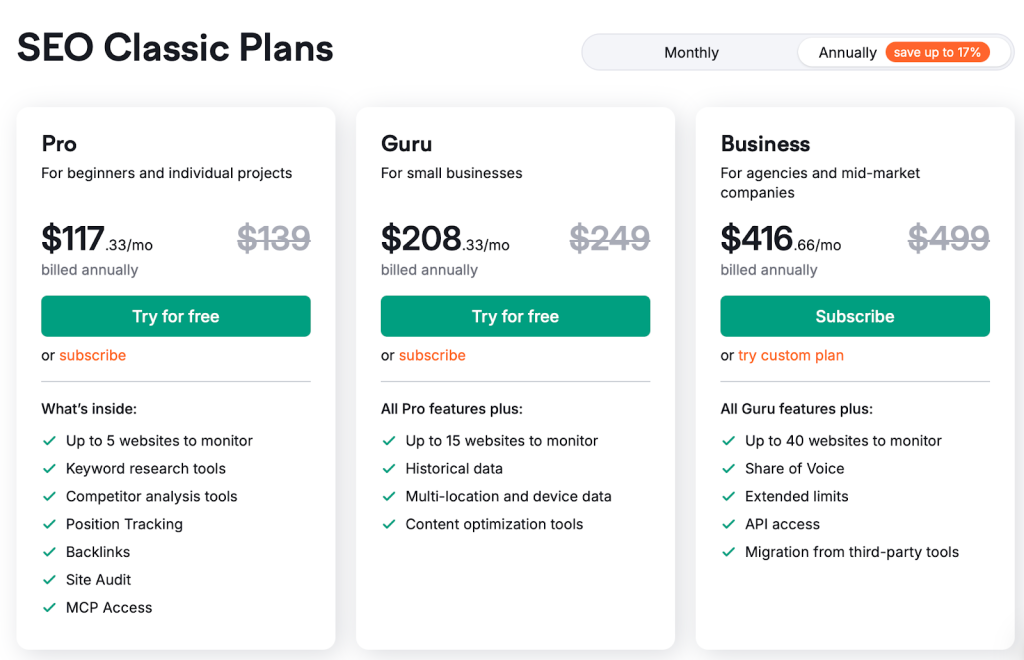
SEMrush offers several pricing tiers depending on the number of projects, tracked keywords, and reports required. Plans generally start at around $129 per month, with higher tiers designed for agencies and larger marketing teams that need additional limits and features. Although the pricing is similar to other premium SEO tools, many users find the value in SEMrush because it combines SEO, PPC, and content marketing tools within a single platform.
Mangools vs Ahrefs vs SEMrush: Feature Comparison
| Feature | Mangools | Ahrefs | SEMrush |
| Keyword Research | KWFinder for finding low-competition keywords | Keywords Explorer with large datasets | Keyword Magic Tool with extensive keyword suggestions |
| Backlink Analysis | LinkMiner for backlink exploration | Site Explorer with one of the largest backlink indexes | Backlink Analytics with link gap analysis |
| Competitor Analysis | SERPChecker and SiteProfiler for quick insights | Deep competitor analysis through Site Explorer | Detailed competitor research across SEO and PPC |
| Rank Tracking | SERPWatcher for monitoring rankings | Rank Tracker with historical performance | Position Tracking with local and device tracking |
| Technical SEO | Limited technical analysis | Site Audit for technical SEO issues | Advanced Site Audit and on-page SEO recommendations |
| Ease of Use | Very beginner-friendly | Moderate learning curve | Feature-rich but more complex |
| Database Size | Smaller datasets | Very large backlink and keyword database | Large keyword and marketing data ecosystem |
| Pricing | Budget-friendly | Premium pricing | Premium pricing |
Why Do People Choose SEMrush?
Many users choose SEMrush because it offers a broader marketing toolkit beyond traditional SEO research.
Some of the main reasons people prefer SEMrush include:
- Access to both SEO and PPC insights in one platform
- A powerful keyword research database with strong filtering options
- Content marketing tools for planning and optimizing articles
- Detailed technical SEO auditing tools
- Competitor research across multiple marketing channels
Final Verdict: Mangools vs Ahrefs vs SEMrush
Mangools, Ahrefs, and SEMrush all serve slightly different types of users.
Mangools focuses on simplicity and affordability, making it a great option for beginners, bloggers, and smaller websites.
Ahrefs provides deep SEO data and powerful backlink intelligence, which is why it’s popular among professional SEOs and agencies working in competitive niches.
SEMrush, however, goes a step further by offering a complete digital marketing platform, combining keyword research, competitor analysis, technical audits, and advertising insights in one place.
Because of this broader toolkit, SEMrush often becomes the most versatile option for marketers who want to manage multiple aspects of their online strategy from a single platform.
If you want more breakdowns like this, along with practical SEO strategies, tool comparisons, and content workflows that actually help pages rank, check out RankingPen, where we regularly analyze the tools and tactics used by real SEO professionals.
