
Quick Summary
Mangools and Semrush are both powerful SEO tools, but they’re built for different types of users. Mangools focuses on simplicity and affordability, making it ideal for bloggers, freelancers, and small businesses that want a straightforward SEO toolkit. Semrush, on the other hand, is a full-scale marketing platform with deeper datasets, advanced competitor analysis, and broader marketing features.
Mangools vs Semrush: Which SEO Tool Should You Choose?
There’s a pattern I’ve noticed after more than five years doing SEO.
As beginners, we usually patch together a mix of cheap and free tools to get by — AnswerThePublic for content ideas, the free version of Mangools for keyword research, a few browser extensions for SERP data, and maybe Search Console to track performance.
It works… for a while.
But as your SEO work grows, you start thinking about a single tool that can bring everything together. At the same time, you start questioning whether paying for a full SEO platform is even worth it.
That’s where the Mangools vs Semrush debate begins. Mangools feels like a natural upgrade from free tools. Semrush, meanwhile, is the full powerhouse.
In this guide, I’ll break down the differences so you can decide which one actually makes sense for you — whether you’re a beginner blogger, a freelancer, or running SEO for multiple sites.
Mangools vs Semrush: Key Differences
Pricing and Affordability
Mangools is designed to be an affordable SEO toolkit, while Semrush positions itself as a premium all-in-one marketing platform.
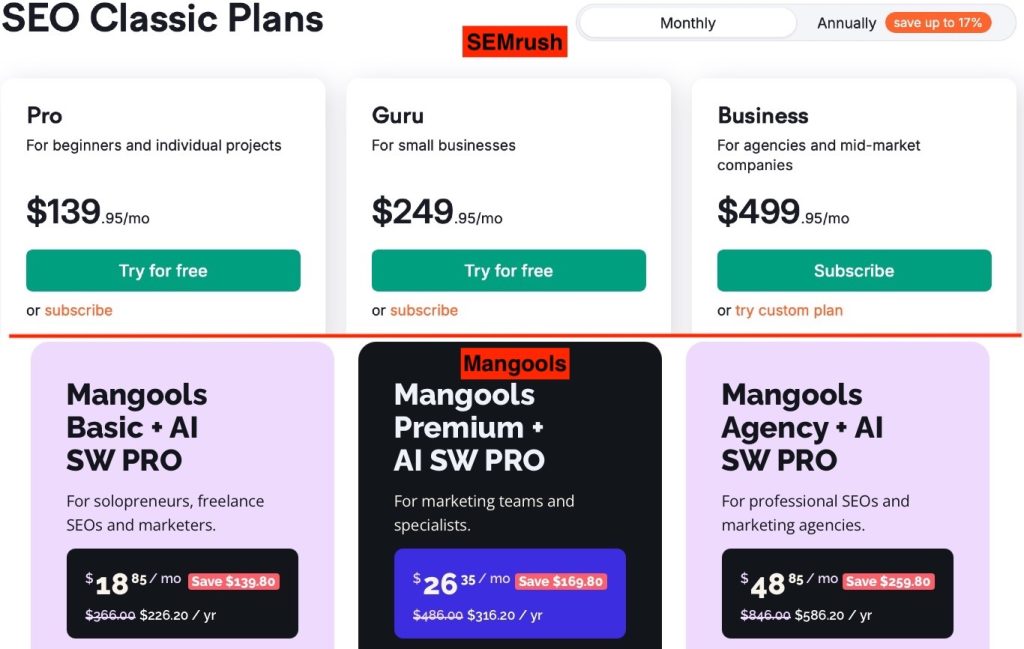
Even when an SEO is convinced that Semrush is the more powerful tool, its cost is usually the reason they give it a second thought.
Semrush’s entry plan starts at around $139.95 per month, with higher tiers unlocking more reports, projects, and advanced features. When compared to Mangools, which starts at roughly $19–$49 per month depending on the plan and billing cycle— that’s about 3–4 times cheaper.
Mangools also tends to be more accessible for beginners through lower pricing tiers and occasional discounts. Semrush does offer a free account and trials, but most of its useful capabilities sit behind the paid plans.
So if you’re a blogger, freelancer, or small site owner looking for a budget-friendly SEO tool, Mangools is usually the easier starting point. But if you’re running SEO at scale, managing multiple sites, or need deeper data and competitor insights, the investment in Semrush may make more sense.
Keyword Research Capabilities
Mangools is built primarily as a keyword research tool, while Semrush approaches keyword research as part of a much larger SEO and marketing platform.
Keyword research sits at the heart of most SEO strategies, so it’s not something you can afford to get wrong.
Both Mangools and Semrush perform well here and cover the core metrics I usually check when evaluating keywords. With both tools, you can enter a seed keyword and filter results by difficulty, search volume, search intent, and other useful parameters.
The main difference I observed is in the depth of keyword data. Semrush tends to surface significantly more keyword variations when its keyword tools are fully explored.
Here’s a quick example.
I searched for the keyword “semrush” using the Keyword Magic Tool in Semrush and filtered for keywords with a difficulty score below 20% (very easy). This produced around 110 keyword ideas, with about 10 visible even on the free plan.
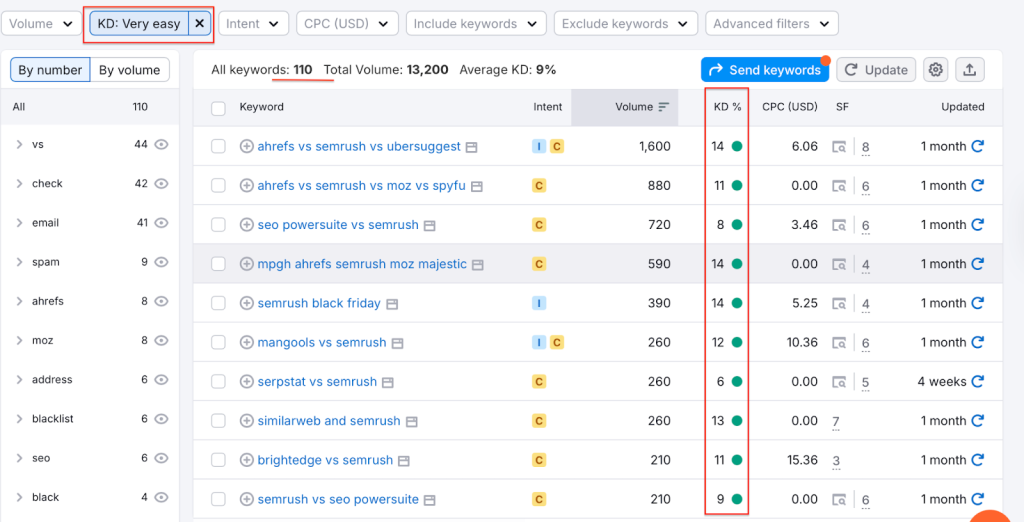
When I ran the same keyword through Mangools’ KWFinder and applied similar filters, I was only able to uncover 3 keyword ideas in that difficulty range.
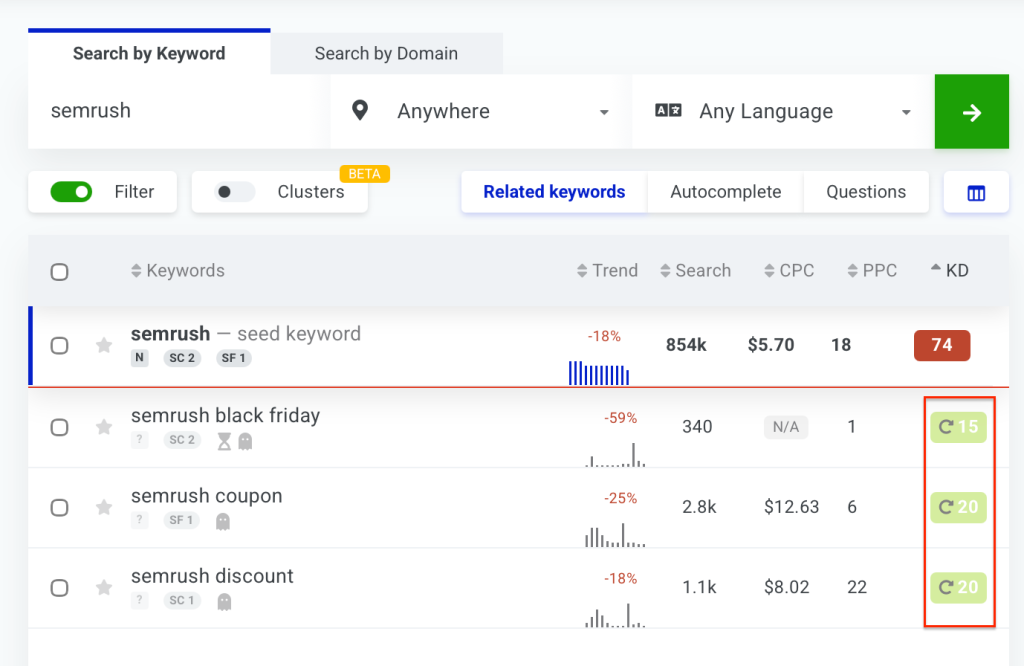
This doesn’t mean Mangools is bad at keyword research. In fact, its interface is excellent for quickly identifying opportunities. But Semrush clearly benefits from a much larger keyword database, which allows it to surface more variations and uncover opportunities that smaller tools might miss.
So if you’re doing light keyword research for a blog or small site, Mangools will likely do the job just fine. But if you’re trying to uncover large keyword clusters, build content strategies, or dig deeper into keyword opportunities, Semrush gives you more data to work with.
Competitor Analysis
Mangools provides simple tools for quick competitor insights, while Semrush offers a much deeper system for analyzing competitors across keywords, traffic, backlinks, and content.
When it’s time to analyze competitors, you’re usually trying to answer a few key questions: who your real competitors are in search, which keywords they rank for, which ones they’re missing, what kind of content performs best for them, and how strong their backlink profiles are.
Both Mangools and Semrush allow you to explore many of these insights. However, the depth and workflow differ quite a bit.
Mangools focuses on giving you a quick snapshot of competitors through tools like SERPChecker and SiteProfiler, which are useful for identifying competing domains, checking basic authority metrics, and reviewing ranking pages.
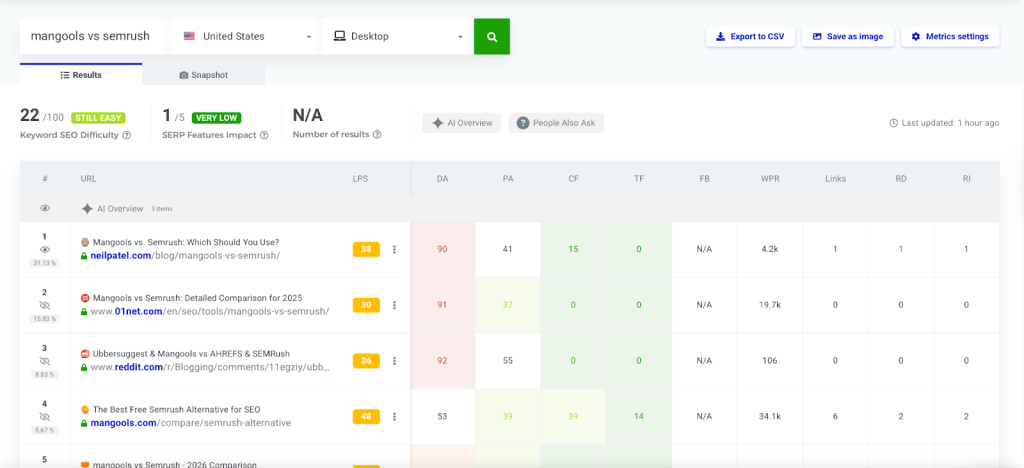
Mangools SERP Checker UI
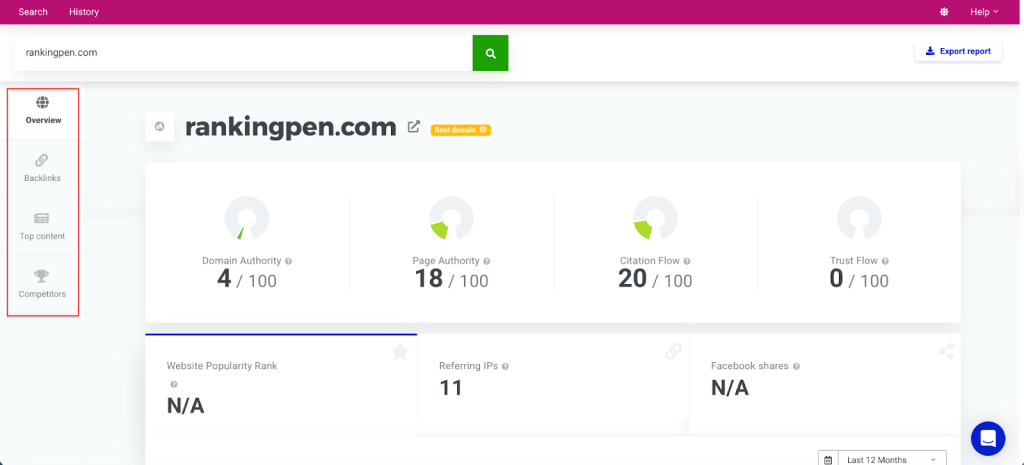
Mangools Site Profiler UI
Semrush, on the other hand, goes much further. It allows you to analyze organic competitors, keyword gaps, backlink gaps, traffic estimates, and even advertising strategies, all within a single dashboard.
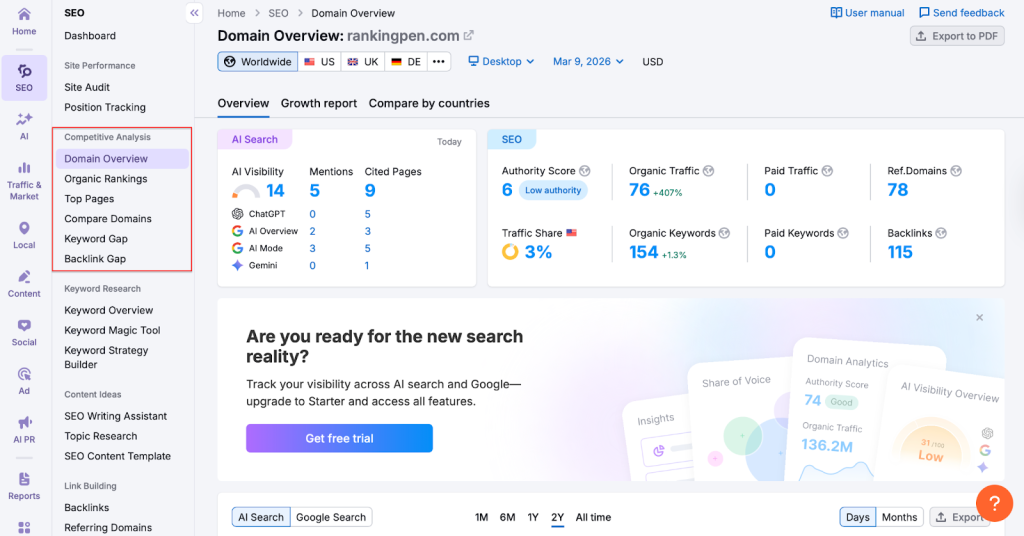
Below is a quick comparison of how both tools approach competitor analysis.
Mangools vs Semrush: Competitor Analysis Comparison
| Feature | Mangools | Semrush |
| Identify SEO competitors | Yes | Yes |
| Keyword gap analysis | Limited | Advanced |
| Competitor keyword rankings | Basic | Extensive |
| Traffic estimation | Limited | Detailed |
| Backlink comparison | Basic | Advanced |
| Content gap analysis | No | Yes |
| PPC competitor insights | No | Yes |
| Market share insights | No | Yes |
What This Means
Mangools works well if you simply want to identify competitors and quickly review their SEO strength. But if your goal is to **reverse-engineer a competitor’s strategy — including their keyword opportunities, content gaps, backlinks, and paid campaigns — Semrush provides far more data and analysis tools.
So if you’re running SEO for a single website or small project, Mangools will likely give you enough insight. But if you’re building competitive SEO strategies, working with clients, or analyzing multiple competitors at scale, Semrush offers a much deeper toolkit.
Backlink Analysis
Mangools offers a simple way to explore backlinks, while Semrush provides a much deeper system for analyzing and auditing link profiles.
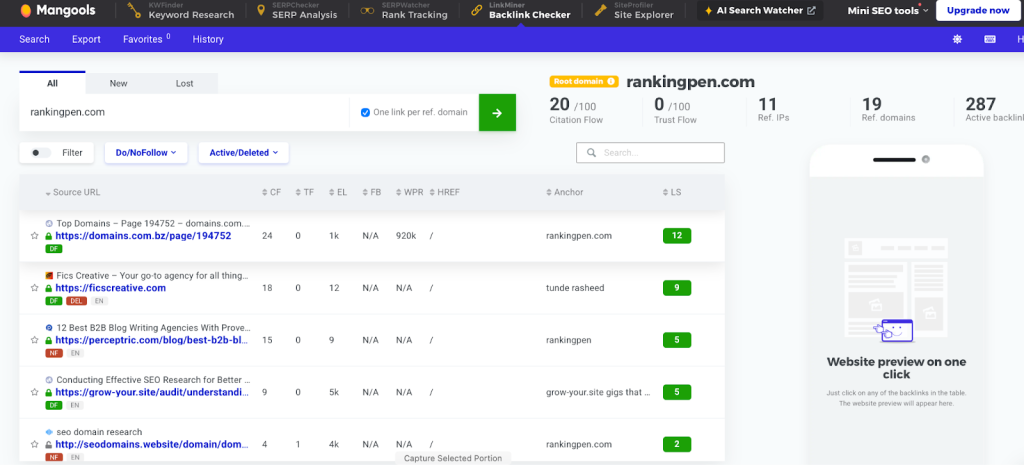
Mangools, staying true to its simplicity-first design, keeps backlink analysis fairly straightforward. It handles this through its LinkMiner tool, which allows you to explore backlinks for any domain or page, evaluate link strength, and quickly identify potential link opportunities.
Semrush’s link-building features do all that too, but take things several steps further. With tools like Backlink Analytics, Backlink Audit, and Backlink Gap, you can analyze complete backlink profiles, compare competitors’ link strategies, monitor new and lost backlinks, and even identify toxic links that might harm your rankings.
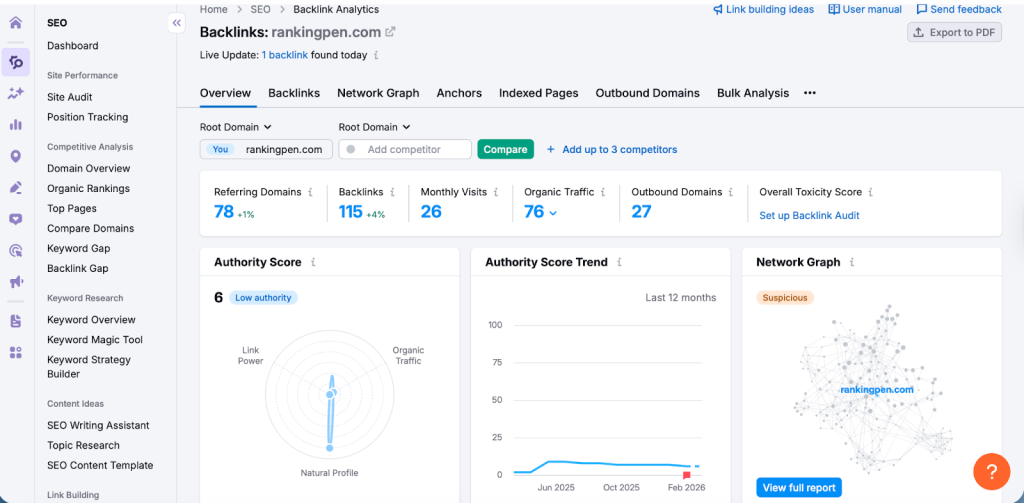
If your goal is simply to discover backlinks and explore link opportunities, Mangools does the job well. But if you want to monitor your backlink profile, audit links, and run deeper competitor link analysis, Semrush provides a much more comprehensive toolkit.
Ease of Use
Mangools is built with simplicity in mind, while Semrush prioritizes depth and functionality.
That difference becomes obvious the moment you start using both tools.
Mangools’ interface is clean, fast, and easy to understand. Most of its tools like KWFinder, SERPChecker, and SERPWatcher, are designed to show the most important metrics without overwhelming the user.
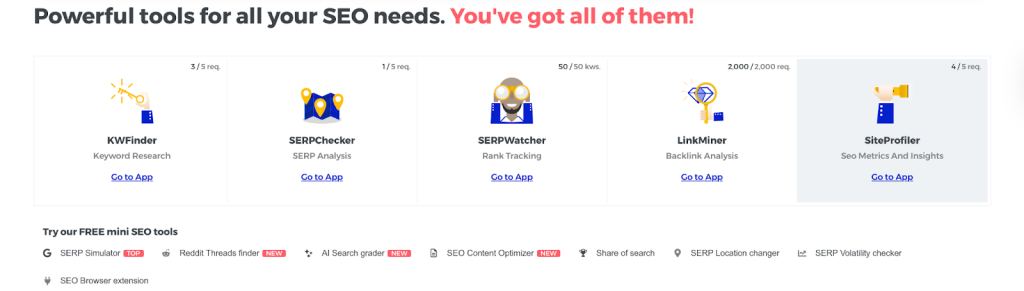
For beginners especially, this makes the workflow much smoother. You can usually run keyword research, check SERPs, or track rankings within minutes of logging in.
Semrush, on the other hand, is far more feature-rich. The platform includes dozens of tools covering keyword research, site audits, backlink analysis, PPC research, content marketing, and more.
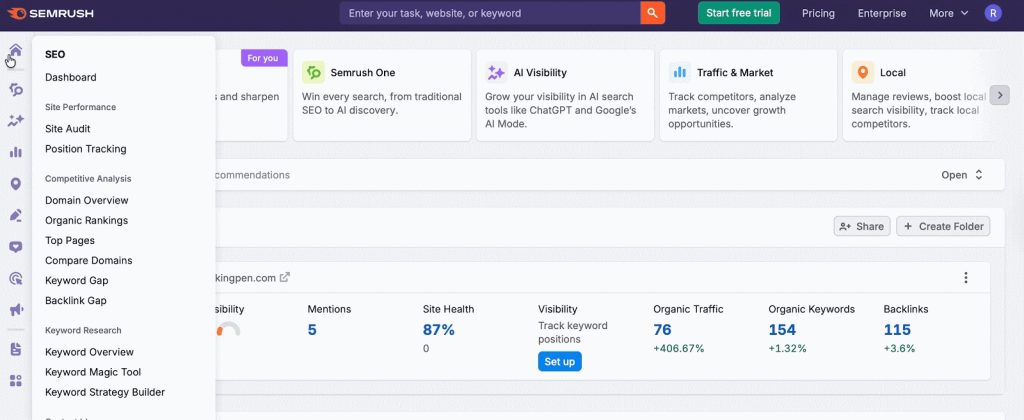
That power comes with a trade-off: the interface can feel overwhelming at first. Many users mention that while Semrush is extremely capable, it can take time to fully understand where everything is and how the different tools connect.
So if you’re looking for a straightforward SEO toolkit that’s easy to learn, Mangools has the advantage. But if you’re comfortable working with more advanced platforms and want access to a broader range of marketing tools, Semrush’s complexity becomes a strength rather than a drawback.
What is Mangools?
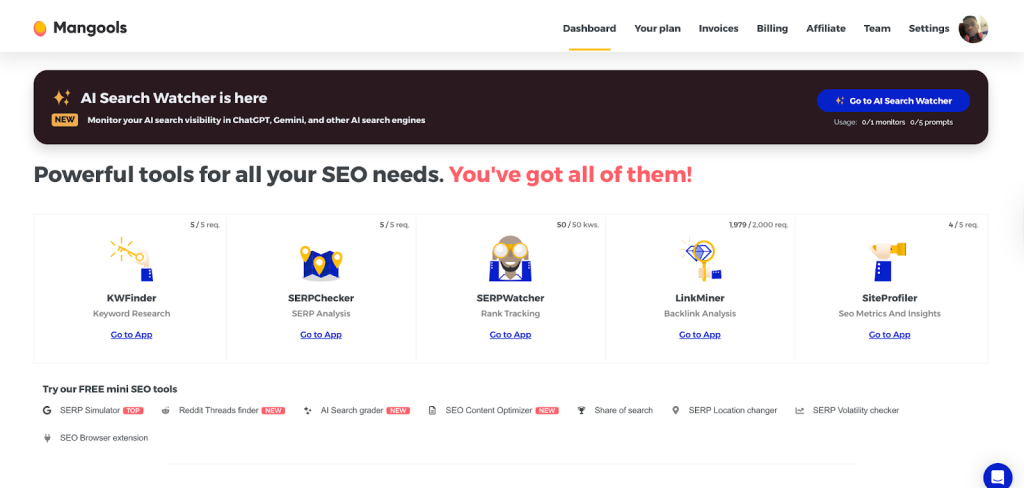
Mangools is a lightweight SEO toolkit designed to make keyword research, rank tracking, and basic SEO analysis simple and accessible. Instead of trying to be an all-in-one marketing platform, Mangools focuses on delivering the core SEO features most users need without unnecessary complexity.
This focused approach has made it become popular among bloggers, freelancers, and small businesses that want reliable SEO insights without the steep learning curve or high costs associated with larger platforms.
Key Features
Mangools includes a suite of tools designed to cover the most common SEO tasks:
- KWFinder: A keyword research tool for discovering keyword opportunities, search volume, difficulty scores, and SERP insights.
- SERPChecker: Allows you to analyze search engine result pages and evaluate how strong the ranking competition is.
- SERPWatcher: A rank tracking tool that monitors keyword rankings and tracks performance over time.
- LinkMiner: A backlink analysis tool that helps you explore link profiles and identify potential link-building opportunities.
- SiteProfiler: Provides quick insights into website authority, backlink strength, and other important SEO metrics.
Pricing
Mangools is widely considered one of the more affordable SEO toolsets on the market.
Its plans typically start around $18.85–$48.85 per month depending on billing cycle, making it far cheaper than most enterprise-level SEO platforms.
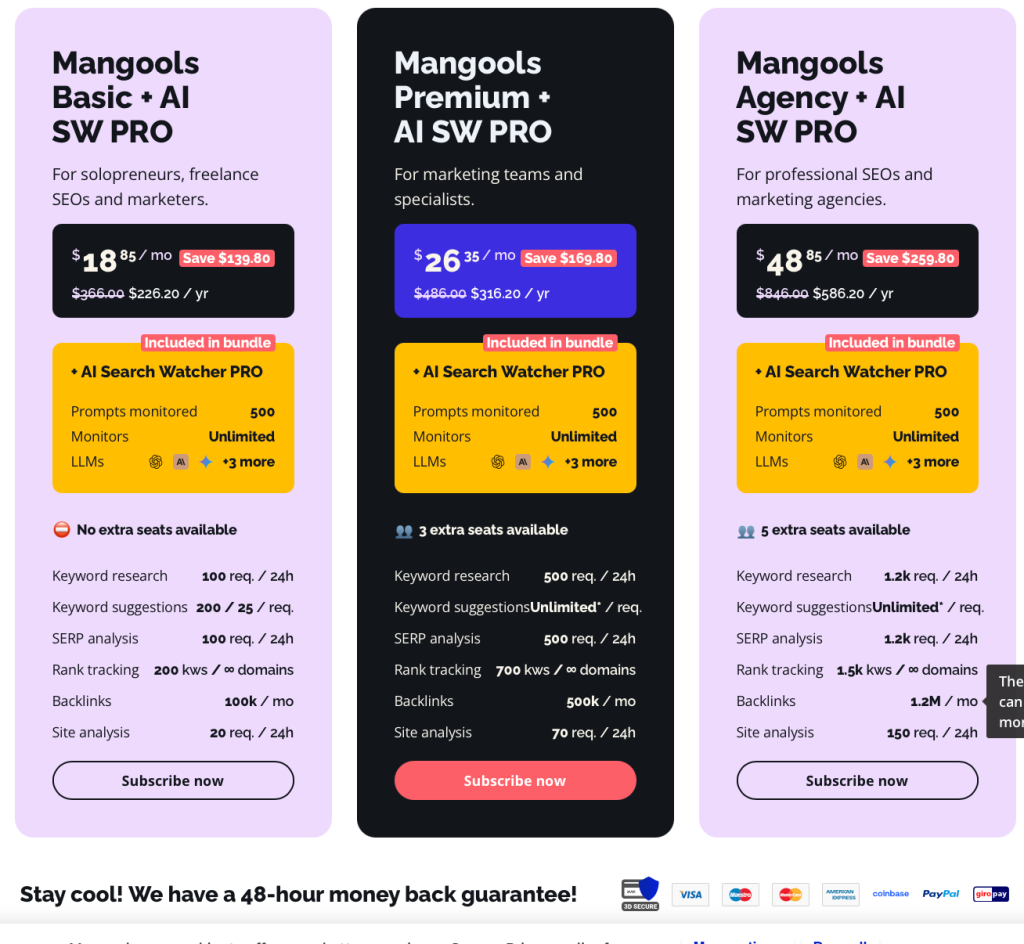
This lower price point makes Mangools an attractive option for users who need solid SEO functionality without committing to the higher monthly costs associated with tools like Semrush or Ahrefs.
Pros and Cons
Pros
- Very easy to use with a clean, intuitive interface
- Affordable pricing compared to most SEO platforms
- Excellent keyword research experience through KWFinder
- Fast workflow for everyday SEO tasks
Cons
- Smaller keyword database compared to larger SEO tools
- Limited competitor analysis features
- Fewer advanced SEO and marketing capabilities
What is Semrush?
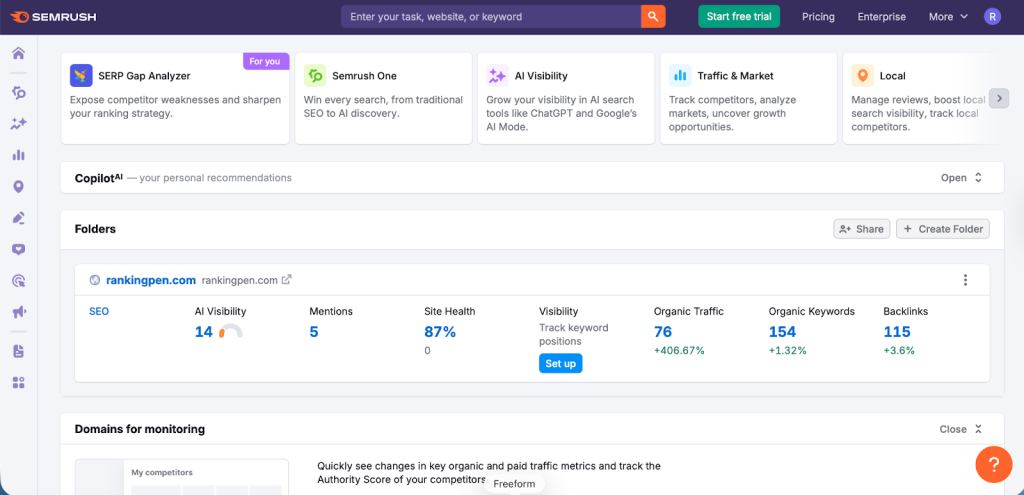
Semrush is a comprehensive digital marketing platform built for businesses, agencies, and professional SEO teams that need deep data and advanced analytics to guide their strategies.
Unlike smaller SEO tools that focus on a handful of core features, Semrush aims to provide an all-in-one marketing toolkit. It combines keyword research, competitor analysis, technical SEO auditing, backlink monitoring, content optimization, and even paid advertising research into a single platform.
Because of its extensive datasets and wide range of tools, Semrush is often used by companies running large SEO campaigns, managing multiple websites, or analyzing competitive markets.
Key Features
Semrush includes a wide range of tools that support different parts of the SEO and digital marketing workflow:
- Keyword Magic Tool: Generates thousands of keyword ideas with metrics like search volume, difficulty, intent, and SERP features.
- Domain Overview:Provides a quick snapshot of any website’s traffic, ranking keywords, and competitors.
- Site Audit: Scans your website for technical SEO issues and suggests fixes to improve performance.
- Backlink Analytics: Allows you to explore backlink profiles, monitor new links, and analyze competitor link strategies.
- Position Tracking: Tracks keyword rankings and performance across locations and devices.
- Content Marketing Tools: Helps generate content ideas, optimize articles, and align content with search intent.
Pricing
Semrush sits at the higher end of the SEO tool pricing spectrum.
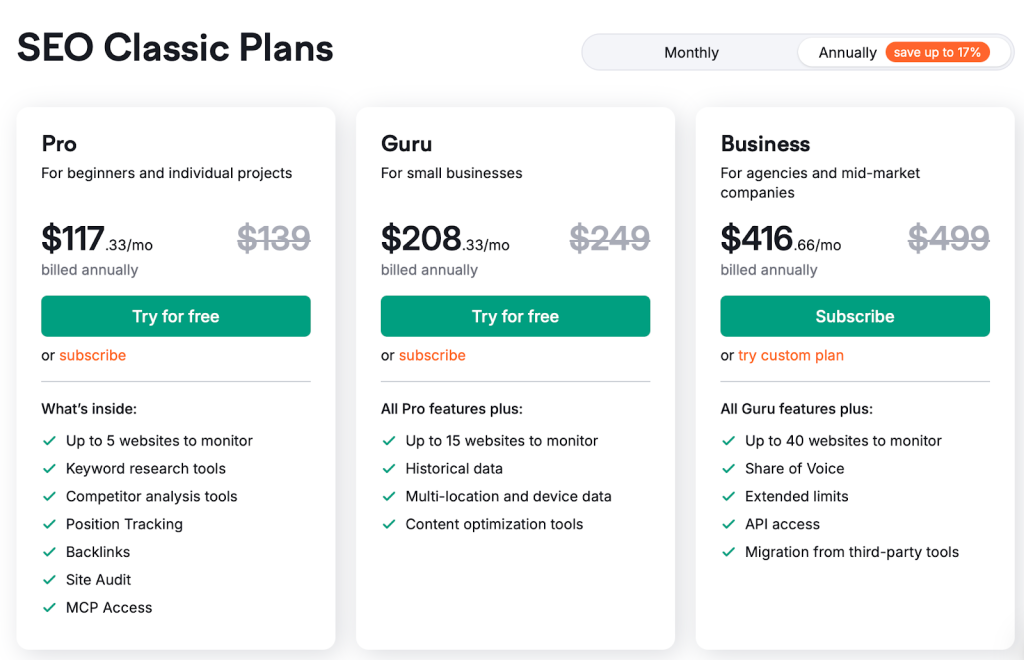
Its entry-level plan typically starts at around $117.33 per month, with higher tiers unlocking more projects, reports, historical data, and advanced features. Additional users and specialized tools can increase the overall cost.
While the price can feel steep for beginners or small websites, the platform’s depth of data and broad feature set make it valuable for teams running larger SEO and marketing operations.
Pros and Cons
Pros
- Massive keyword and backlink databases
- Powerful competitor research tools
- Advanced backlink monitoring and analysis
- Comprehensive all-in-one marketing platform
Cons
- Higher price compared to many SEO tools
- Steeper learning curve for new users
- Feature-heavy interface can feel overwhelming for beginners
Mangools vs Semrush: Feature Comparison
| Feature | Mangools | Semrush |
| Keyword Research | KWFinder for keyword discovery and difficulty analysis | Keyword Magic Tool with massive keyword database |
| SERP Analysis | SERPChecker to analyze ranking pages | SERP insights integrated into multiple research tools |
| Rank Tracking | SERPWatcher tracks keyword positions over time | Position Tracking with advanced monitoring and reports |
| Backlink Analysis | LinkMiner for backlink exploration | Backlink Analytics and Backlink Audit tools |
| Competitor Analysis | Basic competitor insights | Advanced competitor research and keyword gap analysis |
| Technical SEO Audits | Not available | Full Site Audit tool to detect technical issues |
| Content Marketing Tools | Not included | Content optimization and topic research tools |
| PPC and Advertising Insights | Not included | Dedicated tools for PPC research and ad analysis |
| Ease of Use | Very beginner-friendly interface | Powerful but more complex platform |
| Pricing | Lower-cost SEO toolkit | Premium pricing with multiple tiers |
Which Tool Should You Choose?
The right choice between Mangools and Semrush ultimately depends on how advanced your SEO work is and how much data you need to make decisions.
Choose Mangools if:
- You’re a beginner blogger or freelancer
- You want a simple SEO toolkit without a steep learning curve
- Your main focus is keyword research and rank tracking
- You need a budget-friendly SEO solution
Choose Semrush if:
- You’re running SEO professionally or at scale
- You need deep competitor insights and large datasets
- You want an all-in-one marketing platform
- You manage multiple websites or client campaigns
In short, Mangools is ideal if you want a streamlined SEO toolkit that handles the essentials well, while Semrush is the better option if you need a comprehensive platform with deeper analytics and advanced marketing tools.
Final Thoughts: Mangools vs Semrush
Mangools and Semrush are both powerful SEO tools, but they’re built with different users in mind.
Mangools focuses on simplicity and affordability, making it a great option for bloggers, freelancers, and small businesses that want a straightforward SEO toolkit for keyword research and rank tracking. Semrush, on the other hand, is built for depth. With its massive datasets, competitor analysis, and broader marketing tools, it’s often the better choice for agencies and teams running SEO at scale.
But whichever tool you choose, one thing remains true: SEO tools only provide data, results come from how you use that data.
That’s where strategy and execution matter.
If you’re looking to turn keyword insights into high-performing content that actually ranks, that’s exactly what we focus on at RankingPen.
We help SaaS companies and growing brands turn SEO research into well-structured, search-optimized content designed to attract the right audience and drive meaningful traffic.
Because in the end, tools help you discover opportunities, great content is what wins the rankings.
Book a Discovery Call with RankingPen Here.
Frequently Asked Questions
Is Mangools better than Semrush?
Mangools isn’t necessarily better than Semrush, it simply serves a different audience. Mangools is ideal for beginners, bloggers, and small businesses that want a simple and affordable SEO toolkit. Semrush, on the other hand, offers deeper datasets, advanced competitor analysis, and a broader range of marketing tools, making it better suited for agencies and experienced SEO professionals.
Is Mangools good enough for SEO?
Yes, Mangools is good enough for many SEO tasks, especially if you mainly need keyword research, SERP analysis, and rank tracking. Tools like KWFinder and SERPWatcher provide reliable insights for bloggers, freelancers, and small websites. However, if you require advanced competitor analysis, technical SEO audits, and deeper backlink analysis, a platform like Semrush may be more suitable.
Why is Semrush more expensive than Mangools?
Semrush is more expensive because it offers a much larger dataset and a broader set of features. In addition to keyword research and rank tracking, it includes tools for technical SEO audits, competitor analysis, PPC research, backlink monitoring, and content marketing. These additional capabilities make it a full digital marketing platform rather than just an SEO toolkit.
Can Mangools replace Semrush?
Mangools can replace Semrush for basic SEO workflows such as keyword research, SERP analysis, and rank tracking. However, it does not provide the same depth of competitor intelligence, technical SEO auditing, or marketing analytics that Semrush offers. For more advanced SEO campaigns or agency work, Semrush remains the more comprehensive option.
Which SEO tool is better for beginners?
Mangools is generally the better option for beginners because its interface is simpler and easier to learn. The tools are focused on the core SEO tasks most users need, which makes it less overwhelming compared to feature-heavy platforms like Semrush.